Wednesday, 11 July 2012

Which one’s greener?

Do you like nature? Do you love trees? Do you like how the wind blows over the grass and leaves and it twirls and twirls, like how poetry has described them? Well, I do! I love the outdoors, but in Australia, the Sun is the harshest in the world (information from here; teachers tell me all the time wikianswers or yahooanswers are not to be trusted, but I still do!) Every time I walk out of the door without sun screen makes me paranoid, “What if I get cancer? I’m going to die!” And I crawl back indoors. But out of Australia is different, so I search up websites on green countries and here are my results.

The Environmental Performance Index (EPI) had researched about it, and came with The World’s Top Ten Greenest Countries. And that is what I am about to share with you today! Let’s do the countdown, shall we?


10. Colombia –  76.8 (%)
Colombia’s status on eco-friendliness aren’t the best a while ago, but the country didn’t make it to the list until the government cut down the deforestation and organise eco-friendly projects. This tells us if you believe and do it, you can do it, you can end global warming. But that’s another issue… On to the next.

09/08. Cuba, Austria – 78.1 (%)
Although they have the same index, they each have their own ways to go green. Cuba launched a project on supporting hydroelectricity in an area, while Austria built an ecofriendly garden across the border between the Czech Republic (With consent, of course.) Three cheers for them for their effort!

07. France, 78.2 (%)
Who doesn’t love France? The country with sexy accents and cakes that make you water… And don’t forget the magnificent Paris tower! Why, according to the article, their most interesting fact that helps them accomplish their eco goals is the straw bales for construction of buildings!

06. Mauritius, 80.6 (%)
This place, is an island, next to Madagascar (Hey, hey). It’s run by an African Prime Minister and whoever that person is, he is amazing. Despite the limited resources the island have, the PM is able to make his country eco-friendly. Just the thought of it inspires me.

05. Norway – 81.1 (%)
I always like the sound of Norway, ‘Norway’. If you ask me to name a European country, Norway will always be the first one I think. Why? Don’t know. The country itself is an ‘oil export oriented country’ and I’m glad they are putting effort into making carbon neutral!

04. Sweden – 86.0 (%)
According to the article, Sweden has been put so high from the EPI because of the plan they have on discontinuing fossil fuels by 2020. Fossil fuels are stuff deep in the Earth that are decompositions of animals and plants, but becoming into fuel, the liquid that keeps your car going.

03. Costa Rica – 86.4 (%)
In the past, Costa Rica was in need of space to grow their crops, they had to chop down trees. But now, their main goal is to regrow all the trees they have chopped down. From the last five years, they have planted over five million trees. And now, that is amazing!

02. Switzerland, 89.1 (%)
For a few years, Switzerland has been on the EPI list. How do they do it? A lot of motivation! They just kept going and going to make their country even more eco-friendly, even if they are already on the lead. Do you know? In a few small towns, driving cars are prohibited.

And here goes number one. The moment everyone is anticipating… the number one of the world’s greenest country is……


Iceland! With 93.5%!
Remember the Iceland and Greenland irony? Ironically, Iceland became the top of the most greenest on the EPI list. Let’s hope Greenland didn’t come off as the most greenless country! Iceland is consider to be one of the world’s beautiful countries because of the nature. Oh, how I always wanted to visit Iceland! (If you have read my previous entry on the band, Of Monster and Men, they are from Iceland too.) According to statistics, 82% of the electricity and heat in Iceland comes from hydrogen (air) and wind energy in Iceland, only 18% comes from coal. I have to say, I just put Iceland to one of the top of my travel priorities, above London and Paris.


If the information I provide are incorrect, I apologise. There may be arguments and debates on whichever country deserves the top greenest, but this is not the conclusion of my research. It is rank by the Environmental Performance Index, and they have their methods on ranking. For more information on them, here is the place. And more information on the article, click here. It will also provide you reader comments, if you are interested.

Friday, 6 July 2012

Updates: New Twitter account!

We have a new Twitter account! Follow us on @PencilRubbings :-)

Thursday, 5 July 2012

Poaching

Poaching: The act of illegally hunting or catching (game or fish) on land that is not one's own or is under official protection.

I love poaching. It’s an art that requires much skill. People have poached for hundreds of years, and there’s no danger in it dying out. The end result is so tasty! I happen to know a poaching secret or two, and so I’m now going to reveal exclusively to readers of Pencil Rubbings my guide to poaching. No, I’m not referring to illegally sneaking onto someone else’s property shooting their pet deer, and dragging it home for dinner. I’m referring to a different type of poaching.


Poaching: Cooking an egg without its shell in or over boiling water.


Eggs can be healthy, if eaten in relative moderation and if cooked in a healthy way. Poaching is one of these ways. The problem with poaching however is how complicated it is. Poaching an egg the traditional way involves putting water and vinegar into a saucepan, boiling it, stirring the water to make a whirlpool, putting in the shell-less egg (if you’re lucky it won’t completely disintegrate into the water), cooking it for a few minutes, and taking it out. Quite a time consuming breakfast that leaves you with heaps of washing up to do afterwards. And so my grandmother, fed up with all this bother just to get herself a delicious and healthy egg for breakfast, decided to experiment with cooking eggs in the newly-invented microwave she'd just bought herself. Of course, this was before all the fuss about what you can and can’t put in a microwave, so I’m sure she may indeed have begun her experimentation by putting a whole egg, in its shell, into the microwave.

(Don’t do that, by the way. Let’s just say you end up with a very sticky situation. And perhaps in need of a new microwave. If you don't believe me, watch some of the YouTube videos.)


So with a little more experimenting, she discovered how to poach an egg in the microwave, with minimal dishes, time, effort, and explosions. She then eventually told my mother, and my mother eventually told me. Now I’m sharing this closely guarded secret that has been passed down the generations with the Pencil Rubbings community! Although I somehow think that it’s more likely that my “closely guarded secret” was similarly discovered by many other people a long time ago, and is already all over the microwave-possessing part of the world anyway. I really have no idea. Anyway, here it is. How to poach an egg in the microwave. Obviously this only works if you have a microwave oven. I really don't know how common microwaves are outside my own country, so if you have no idea what I’m talking about, then disregard this recipe.


You’ll need:
-An egg (No need to leave it out of the fridge before-hand. Not like when you’re making cakes.)
-A microwave (No need to leave it out of the fridge before-hand either. Assuming you store your microwave in the refrigerator.)
-Bread (Assuming you wish to eat toast with your egg.)
-Toaster (Assuming you want your toast to be toasted, as opposed to raw.)
-Glad-wrap (also known as cling-wrap. The plasticky stuff that people use to wrap things. Like sandwiches, not presents. You know, this sort of thing:
)

-A knife and fork (Not the Murder-Weapon-Knife, or even the Kitchen-Chopping-Things-Knife. Just an ordinary Spreading-Butter-Knife will do.)
-A plate (Unless you want to save on washing up by eating off the bench. But I would not recommend this; very unhygienic.)
-A microwavable cup. (Do check that it’s microwavable. Best results will be if the base is round and about the same size as what a regular poached egg is. Something like this:
)

-Salt and pepper (Depending on taste, or how healthy you want to be.)
-Margarine/butter/table-spread/any other yellow or white stuff you spread on toast
-An adult’s supervision (It’s obligatory, I know.)

The rest is easy.
1. Put a slice of bread in the toaster. You may need to get the afore-mentioned adult to help you cut it if it hasn’t been cut yet.
2. Crack the egg into the cup. Make sure there’s no shell in the egg, you don’t want a crunchy poached egg.
3. Use the fork to prick the yolk. You’re not trying to mix it in, all that’s needed is a quick prick. There shouldn’t be any difference to the naked eye, but this will help prevent the yolk from...gulp...exploding.
4. Cover the top of the cup with the cling-wrap.
5. Possibly the most important step: use that ever handy fork to prick holes in the glad wrap. Probably about three good pokes around the centre of the glad-wrap (but only little holes, don't let them join up to make big holes).


Nope, I haven't put two eggs in (although you can do that if you want). I somehow managed to get a double-yolker egg when I took that photo (that's an egg with two yolks in it if you didn't know).
6. Start the toaster. (The idea here is to try and sync things up so the toast finishes cooking at the same time as the egg does; but this’ll really depend on your toaster and microwave.)
7. Put the cup with the egg in it into the microwave, and cook it for 10 seconds on High (which should be the default setting anyway).
8. This is where things get a little challenging. You want the egg white to cook through, but ideally you want the yolk to still be a little bit runny. After 10 seconds, take the cup out, inspect, and give it a little swirl to make sure it’s cooking evenly. It’ll probably need a little longer. So, put it in for another 10 seconds or so, and continue this procedure until the white looks mostly solid.


9. If you hear a “bang,” there are two things you need to do.
    (a.)  Don’t panic. There’s nothing the matter. All that’s happened is the yolk has exploded. That’s why you put the cling wrap on top of the cup. It just means that your egg won’t quite be cooked as it should, with the yolk a little too crumbly, instead of runny. It’s still definitely edible, and quite tasty. Just blame your adult supervisor for it not being perfect. And stop it earlier next time.
    (b.)  Stop the microwave straight away, and take out the egg.
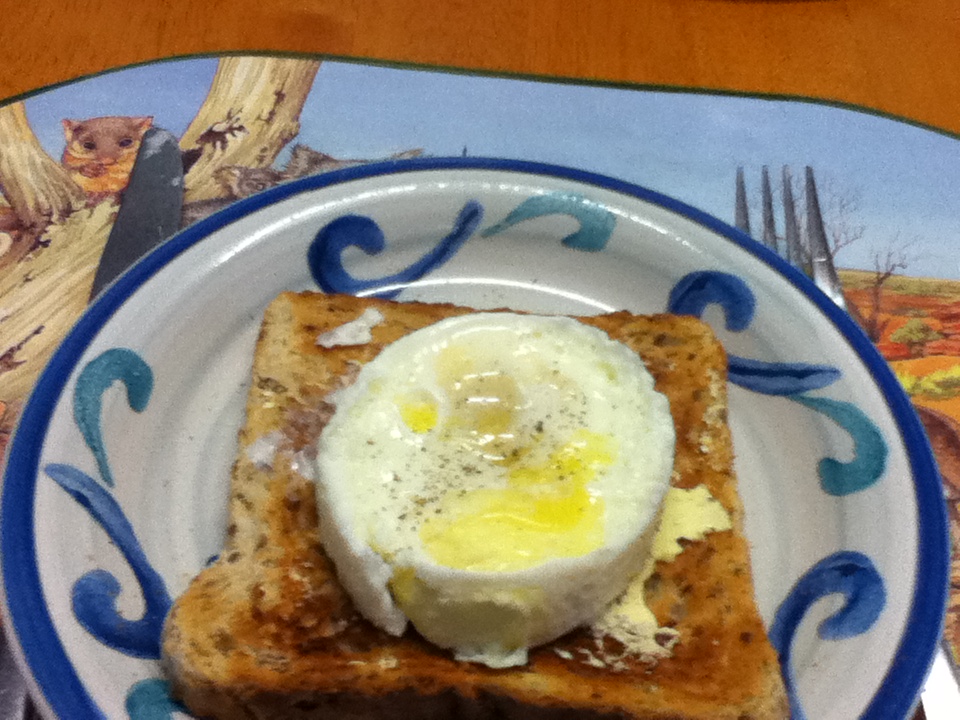
10. Use the knife to spread the spready stuff onto the toast once it’s cooked, and then use the knife to go round the egg in the cup so it tips out easily onto your toast. Put salt and pepper over the egg if you wish, and then enjoy eating your egg with that ever useful knife and fork.


Wow. That seems rather complicated. It isn’t. Getting the egg cooked just right may take a few attempts, but it’s certainly easier than the traditional poaching method. And there’s far less dishes as well. Just a plate, a cup, a knife, and a fork. Try it. At the very least you’ll be able to tell your friends about how you’re now officially a poacher.